


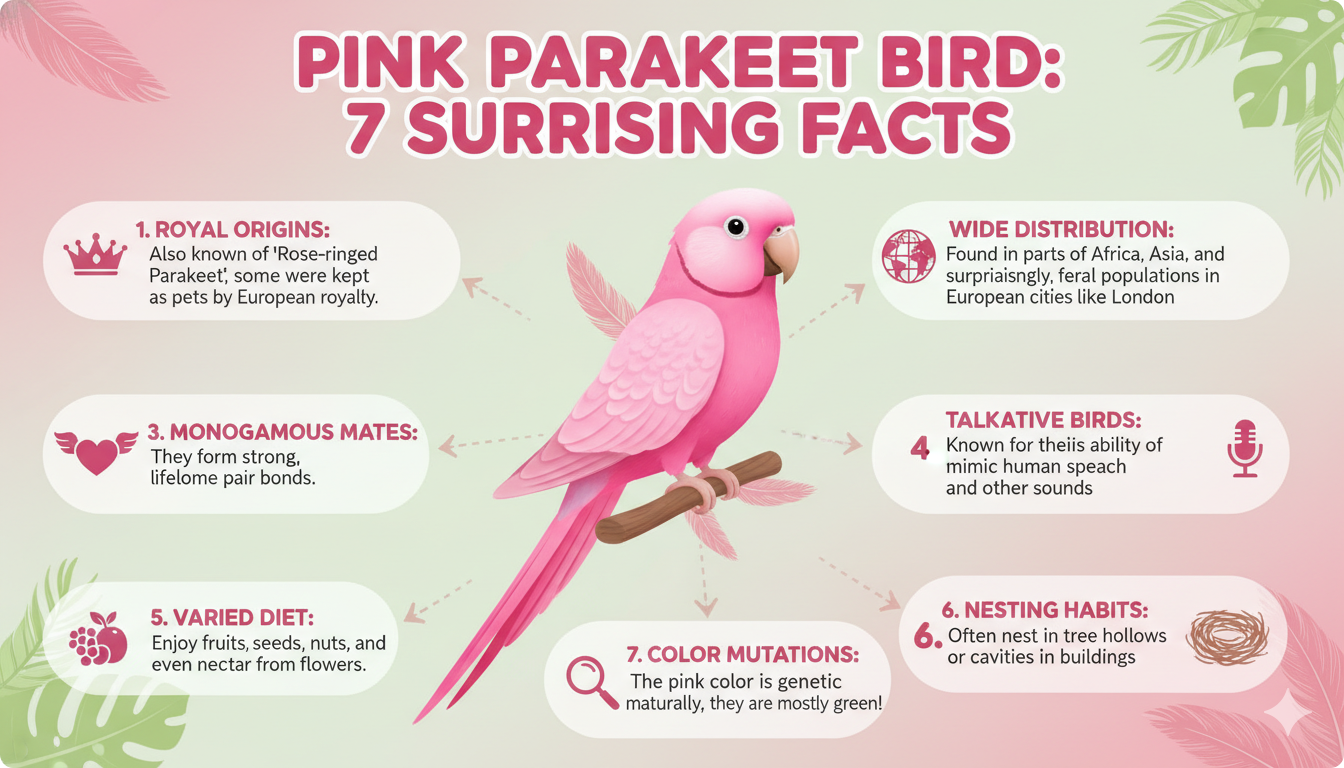
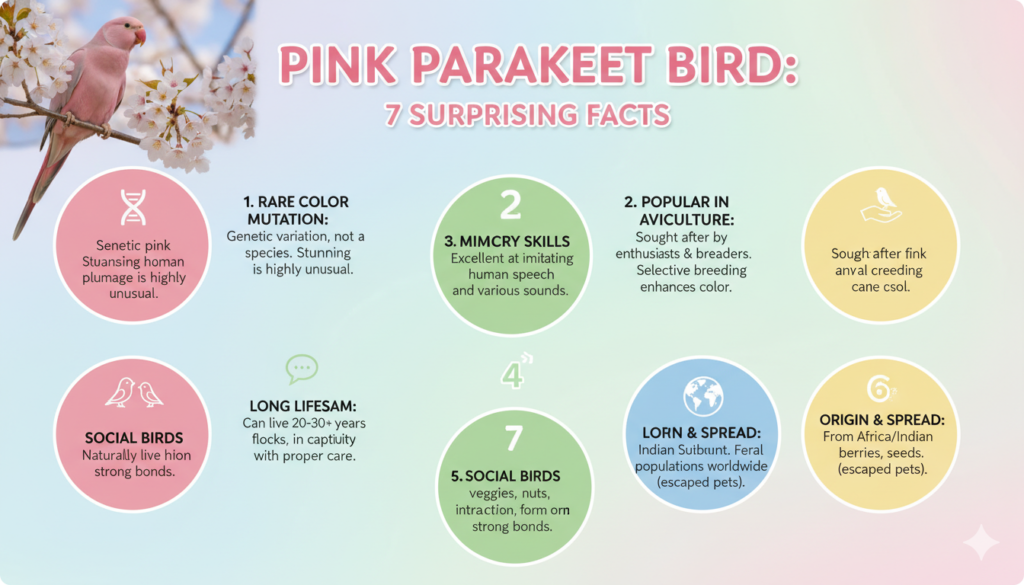
Have you ever been captivated by the sight of a stunning pink parakeet bird? These beautiful creatures with their soft, rosy plumage have become increasingly popular among bird enthusiasts and pet owners worldwide.
The pink parakeet bird represents one of nature’s most charming creations, combining delicate beauty with engaging personality traits that make them irresistible companions. In this comprehensive guide, we’ll explore seven surprising facts about pink parakeet birds that will deepen your understanding and appreciation of these remarkable feathered friends.
Whether you’re considering bringing a pink parakeet bird into your home, you’ve already fallen in love with one, or you’re simply curious about these rosy-hued parrots, these surprising facts will reveal aspects of these birds you may never have known.
From their unique genetics to their unexpected behaviors, let’s uncover what makes the pink parakeet bird truly extraordinary.
Understanding the Pink Parakeet Bird
Before diving into our surprising facts, let’s establish what a pink parakeet bird actually is and why they appear pink.
What Creates Pink Coloring?
Here’s the first surprise: genuinely pink wild parakeets don’t exist in nature. The pink parakeet bird you see results from specific genetic mutations or selective breeding in captivity.
How pink develops:
- Specific color mutations that alter normal pigmentation
- Selective breeding by experienced breeders over multiple generations
- Combination of genetic factors affecting feather color
- Different mutations create various shades from pale peachy-pink to vibrant rosy-pink
Natural exceptions: The Bourke’s parakeet is the closest to having natural pink, with wild birds displaying pink chest and belly feathers. The rosy mutation intensifies this natural coloring.
Species That Come in Pink
When people search for pink parakeet bird options, they typically find:
Bourke’s Parakeet: Native to Australia, these birds naturally have pink coloring. The rosy mutation creates the most genuinely pink parakeets available.
Budgerigars (Budgies): Through specific mutations like albino, lacewing, and fallow, budgies can appear pinkish, especially in certain lighting.
Lineolated Parakeets: Some mutations produce soft salmon or peachy-pink coloring.
Princess Parrots: These Australian birds have natural pink throat patches.
Pink Parakeet Birds Don’t Actually Have Pink Pigment
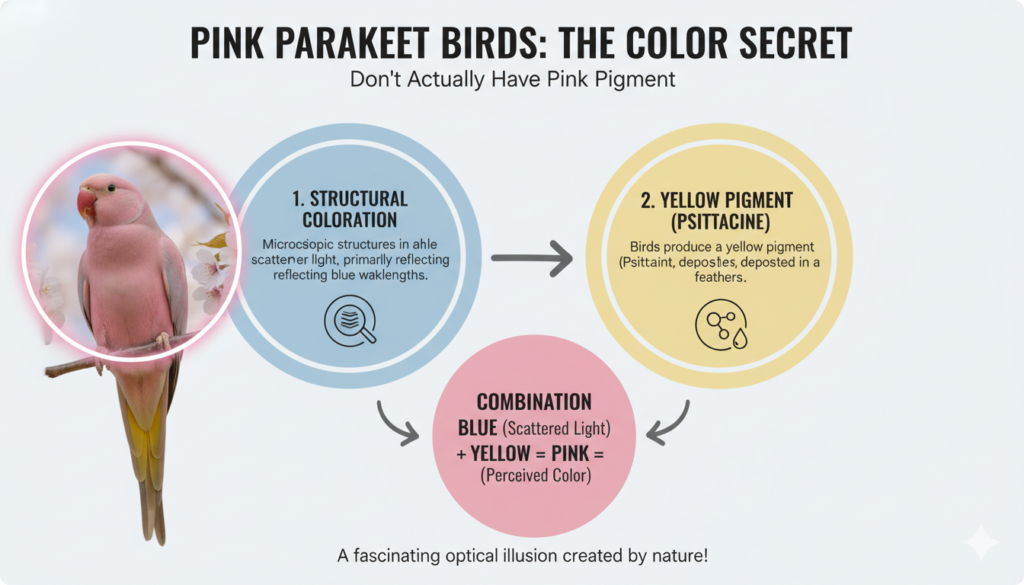
This fact surprises most people: the pink parakeet bird doesn’t have pink pigment in their feathers at all!
The Science Behind Bird Colors
Bird coloring works differently than you might think:
Two main pigment types:
- Melanin: Creates blacks, browns, and greys
- Carotenoids: Creates reds, oranges, and yellows
Structural colors: Some colors, especially blues, come from feather structure rather than pigment. Light reflects off microscopic structures in specific ways.
How Pink Actually Forms
The pink parakeet bird gets its color through fascinating processes:
Reduction of melanin: Mutations that reduce or eliminate dark melanin allow lighter base colors to show through. This creates pastel or pinkish tones.
Combination effects: When you combine reduced melanin with yellow pigments, the result can appear peachy or pink to our eyes.
Light reflection: The way light reflects off feather structures combined with underlying pigments creates the pink appearance we see.
True pink exception: Bourke’s parakeets do have actual pinkish pigmentation, making them the truest pink parakeet bird available. The rosy mutation intensifies their natural coloring.
Why This Matters
Understanding that pink parakeet bird coloring comes from genetic mutations rather than simple pigment has important implications:
Breeding complexity: Creating pink birds requires deep understanding of genetics and careful selective breeding over multiple generations.
Rarity: Because pink requires specific genetic combinations, truly pink parakeets are less common than standard colors.
Price differences: The complexity of producing pink parakeet birds often means higher prices compared to common color mutations.
Health considerations: Some color mutations, when combined incorrectly, can cause health issues. Responsible breeders prioritize health alongside color.
The Pinkest Parakeet Bird Is Actually From Australia
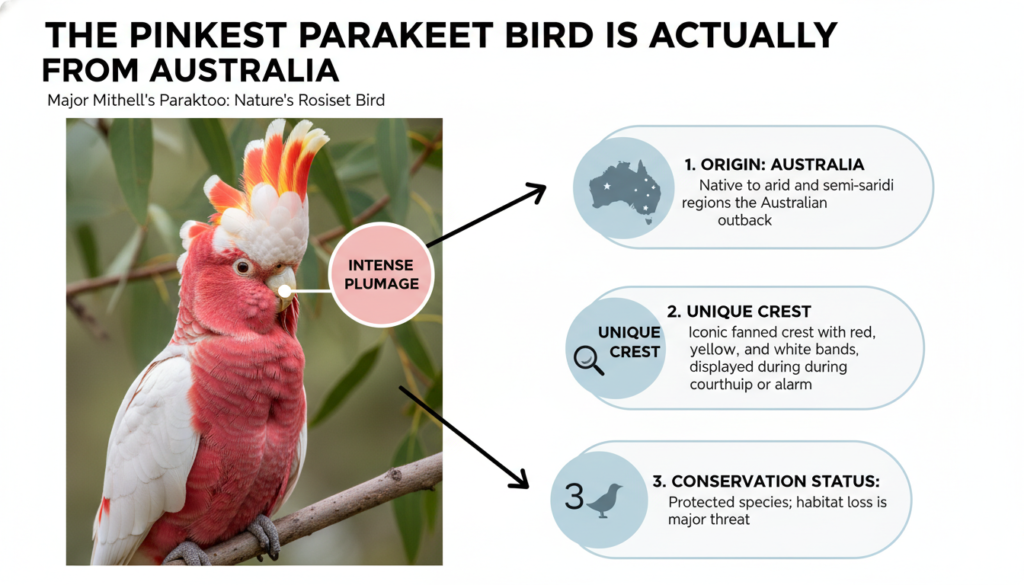
Most people searching for pink parakeet bird options don’t realize that the truest pink comes from a less commonly known species.
Meet the Bourke’s Parakeet
The Bourke’s parakeet is the champion pink parakeet bird:
Natural pink: Even wild Bourke’s parakeets have pink chest and belly feathers, making them naturally one of the pinkest parakeet species on Earth.
Native habitat: These birds come from the arid interior regions of Australia, where they inhabit scrublands and grasslands.
Size: Bourke’s parakeets measure 7-8 inches long, making them slightly smaller than budgies in length but similar in weight.
Rosy mutation: Selective breeding has created the rosy Bourke’s, which features intensified pink coloring throughout the chest, face, and abdomen.
Why Bourke’s Parakeets Are Special
The pink parakeet bird characteristics of Bourke’s make them unique:
Genuine pink: Unlike budgies where pink depends on lighting and perception, rosy Bourke’s are genuinely, vibrantly pink all the time.
Gender differences: Male rosy Bourke’s display brighter, more intense pink than females. Adult males have brilliant pink face, chest, and belly with soft blue-grey wings and back.
Underappreciated: Despite being the truest pink parakeets available, Bourke’s remain less well-known than budgies or cockatiels.
Excellent pets: Beyond their color, Bourke’s parakeets make wonderful companions with gentle, calm personalities.
Surprising Bourke’s Behaviors
This pink parakeet bird species has unexpected traits:
Crepuscular activity: Unlike most parakeets that are active during the day, Bourke’s are most active at dawn and dusk. This makes them perfect for people who work during the day.
Quiet nature: Bourke’s parakeets are among the quietest parakeet species, making them ideal for apartments or close living situations.
Gentle temperament: They’re notably calm and gentle compared to the high-energy, sometimes nippy nature of budgies.
Independent streak: While social and bonding well with humans, Bourke’s are less demanding of constant attention than some species.
Pink Parakeet Birds Can Be Quieter Than You’d Expect
When most people think of parakeets, they imagine noisy, chattering birds. But some pink parakeet bird species surprise with their quiet nature.
Volume Levels by Species
Different pink parakeet bird types have vastly different noise levels:
Bourke’s Parakeets:
- Among the quietest parakeet species
- Soft chirps and twitters rather than loud calls
- Rarely scream or make disruptive noises
- Vocalizations are gentle and pleasant
- Perfect for apartments or shared living spaces
Budgerigars:
- Moderate volume compared to larger parrots
- Can be quite chatty with constant chirping
- Morning and evening calling sessions
- Some individuals learn to talk, which can be loud
- Males typically more vocal than females
Lineolated Parakeets:
- Very quiet compared to most parrots
- Soft whistles and gentle chirps
- Rarely loud enough to disturb neighbors
- One of the best choices for noise-sensitive situations
Surprising Vocalizations
The pink parakeet bird communicates in unexpected ways:
Song-like sounds: Bourke’s parakeets produce melodious, song-like vocalizations that many people find soothing rather than annoying.
Contact calls: All parakeets use contact calls to locate flock members, but Bourke’s calls are surprisingly soft.
Talking ability: While Bourke’s rarely become great talkers, budgies (including pink-toned varieties) can develop impressive vocabularies of 50-100 words.
Mimicry: Some pink parakeet birds, especially budgies, perfectly mimic household sounds like phone rings, microwaves, and alarm clocks.
Managing Noise
Even quiet pink parakeet birds sometimes need volume management:
Morning calling: Most parakeets are loudest at dawn, which corresponds to natural flock activity times. Covering cages can help manage this.
Attention-seeking: Birds that don’t receive adequate interaction may scream for attention. Proper daily engagement prevents this behavior.
Pair dynamics: Two birds together are typically noisier than a single bird, as they communicate with each other throughout the day.
Environmental triggers: Outside noises like sirens, other birds, or loud music can trigger vocalizations.
Pink Parakeet Birds Have Unexpected Lifespans
Many people assume small birds live only a few years, but pink parakeet birds often surprise with their longevity.
Lifespan by Species
Different pink parakeet bird types live varying lengths:
Bourke’s Parakeets:
- Average lifespan: 10-15 years
- With excellent care: 15-18 years
- Some individuals reach 20+ years
- Longer-lived than many small parrots
Budgerigars:
- Average lifespan: 8-12 years
- With excellent care: 12-15 years
- Record ages exceed 20 years
- Seed-only diets dramatically reduce lifespan
Lineolated Parakeets:
- Average lifespan: 10-15 years
- With excellent care: 15-20 years
- Comparable to Bourke’s parakeets
Princess Parrots:
- Average lifespan: 20-30 years
- These larger parakeets live significantly longer
- Require longer commitment than smaller species
Surprising Longevity Factors
What helps pink parakeet birds live longer:
Diet quality: This is the single biggest factor. Birds eating balanced diets with pellets and fresh vegetables live dramatically longer than those on seed-only diets.
Mental stimulation: Engaged, enriched birds with toys, training, and social interaction typically outlive bored, neglected birds.
Exercise: Daily flying and physical activity maintains cardiovascular health and prevents obesity-related health problems.
Genetics: Some birds inherit superior health from well-bred lineages, while others may have genetic predispositions to certain conditions.
Veterinary care: Regular checkups catch health problems early when they’re most treatable, significantly extending lifespan.
Accident prevention: Many premature deaths result from preventable accidents like flying into windows, toxic exposure, or attacks from other pets.
Commitment Considerations
The long lifespan of pink parakeet birds means:
Decade-plus commitment: Getting a parakeet means caring for them for potentially 10-20+ years.
Life stage planning: Your bird will be with you through major life changes like moves, career shifts, relationships, and possibly children.
Financial planning: Budget for 10-20 years of food, supplies, toys, and veterinary care.
Future planning: Consider what happens to your pink parakeet bird if you can no longer care for them. Include provisions in your will.
Pink Parakeet Birds Are More Affordable Than Most Exotic Pets
Despite their unusual and beautiful coloring, pink parakeet birds remain surprisingly budget-friendly.
Purchase Price Comparisons
The cost of pink parakeet birds varies but remains reasonable:
Bourke’s Parakeets:
- Normal coloring: $100-$150
- Rosy mutation: $150-$250
- Show quality: $200-$350
- Significantly less than many exotic pets
Pink-Toned Budgies:
- Albino: $30-$60
- Lacewing: $40-$80
- Fallow: $35-$70
- Very affordable for unusual coloring
Lineolated Parakeets:
- Standard colors: $150-$250
- Pink mutations: $200-$350
- Moderate pricing for rarer species
Comparison to other pets:
- Cats: $50-$150 (adoption) to $500-$2,000 (purebred)
- Dogs: $500-$3,000+
- Larger parrots: $1,000-$5,000+
- Exotic reptiles: $200-$2,000+
Setup and Ongoing Costs
The pink parakeet bird remains affordable long-term:
Initial setup ($250-$600):
- Cage: $80-$250
- Perches and accessories: $30-$60
- Toys: $25-$50
- Dishes: $15-$30
- Food: $20-$40
- Carrier: $25-$50
- First vet visit: $75-$150
Monthly costs ($25-$60):
- Food: $15-$30
- Toys: $5-$15
- Bedding: $5-$10
- Treats: $3-$8
Annual costs ($160-$440):
- Vet checkup: $75-$200
- Toy replacement: $60-$180
- Grooming: $30-$60
Lifetime Cost Surprise
Over a 15-year lifespan, a pink parakeet bird costs:
- Initial: $400-$1,000
- Monthly (15 years): $4,500-$10,800
- Annual vet care: $1,125-$3,000
- Total: $6,025-$14,800
Compare this to:
- Dog (12 years): $15,000-$35,000+
- Cat (15 years): $12,000-$25,000+
- Large parrot (40 years): $40,000-$80,000+
The pink parakeet bird offers exotic beauty and companionship at a fraction of the cost.
Value Considerations
Why pink parakeet birds offer excellent value:
Long companionship: 10-20 years of friendship for modest investment Low maintenance: Require less time and money than many pets Space-efficient: Small cages fit in apartments and small homes Entertainment value: Provide hours of enjoyment daily Educational: Teach children responsibility and animal care Therapeutic: Reduce stress and provide emotional support
Pink Parakeet Birds Are Smarter Than Most People Think
Small size often leads people to underestimate intelligence, but pink parakeet birds surprise with their cognitive abilities.
Problem-Solving Skills
The pink parakeet bird demonstrates impressive intelligence:
Puzzle solving: Many parakeets figure out puzzle toys, foraging boxes, and other brain teasers designed for birds.
Latch manipulation: Owners frequently report their pink parakeet birds learning to open cage doors, food dish latches, and toy mechanisms.
Tool use: Some parakeets use objects to reach food or accomplish goals, demonstrating planning and reasoning.
Cause and effect: Birds quickly learn that specific actions produce results, then use this knowledge strategically.
Pattern recognition: Parakeets recognize routines, anticipate events, and remember sequences.
Learning Abilities
Pink parakeet birds are surprisingly trainable:
Trick training: Many learn impressive tricks including:
- Stepping up on command
- Coming when called
- Playing basketball
- Retrieving objects
- Waving or shaking hands
- Turning in circles
- Navigating obstacle courses
Talking skills: Budgies, including pink-toned varieties, rank among the best talking birds. Some individuals learn 50-100+ words with clear pronunciation.
Contextual learning: Smart pink parakeet birds learn to use words appropriately in context, making their communication seem more meaningful.
Observational learning: Birds learn by watching both other birds and their human companions, then mimicking behaviors.
Memory Capabilities
The pink parakeet bird has surprising memory:
Long-term memory: Birds remember people, places, and experiences for years. A pink parakeet bird can recognize someone they haven’t seen in months or even years.
Routine memory: They remember daily schedules, anticipating feeding times, play times, and owner arrivals.
Spatial memory: Birds remember cage layouts, room configurations, and hiding spots for food.
Social memory: They remember which people treat them well and which they should avoid, showing clear preferences.
Intelligence Comparison
How pink parakeet bird intelligence compares:
Parakeets vs. other birds: Parakeets, especially budgies, rank high among small parrots for intelligence. They surpass finches and canaries in problem-solving and learning.
Parakeets vs. larger parrots: While not matching the intelligence of African greys or cockatoos, parakeets still demonstrate impressive cognitive abilities relative to their size.
Parakeets vs. other small pets: They significantly outperform hamsters, gerbils, and most other small cage pets in trainability and problem-solving.
Pink Parakeet Birds Have Unexpected Social Needs
Many people assume small birds are low-maintenance pets, but pink parakeet birds have surprising social requirements.
High Social Drive
The pink parakeet bird is more social than expected:
Flock instinct: In the wild, parakeets live in large flocks with complex social structures. This drive remains strong in captive birds.
Human bonding: Single pink parakeet birds view their human family as their flock and form deep attachments.
Time requirements: Most parakeets need 1-3 hours of daily interaction to remain mentally healthy and well-adjusted.
Attention-seeking: Neglected birds develop behavioral problems including screaming, feather plucking, and aggression.
Companionship Decisions
Surprising considerations for pink parakeet bird social needs:
Single vs. pairs:
- Single bird: Bonds closely with humans, often talks more, easier to handle, requires more human time
- Paired birds: Provide companionship for each other, less dependent on humans, may bond more with each other than people, noisier
Species mixing: Generally not recommended. Different parakeet species have different social behaviors and communication styles that don’t always translate well.
Gender considerations: Same-sex pairs work well and avoid breeding. Mixed pairs will breed if given nest boxes.
Age introductions: Introducing new birds to established birds requires quarantine and slow, supervised introductions.
Unexpected Emotional Complexity
Pink parakeet birds experience surprising emotions:
Joy and excitement: Displayed through singing, dancing, wing-flapping, and playful behavior.
Affection: Shown by preening favorite people, regurgitating food (a sign of love in birds), and seeking physical closeness.
Jealousy: Some birds become possessive of favorite people and show aggression toward perceived rivals.
Grief: Birds that lose companions or favorite people can become depressed, stop eating, and even die from grief.
Anxiety: Changes in routine, environment, or social structure can cause stress and behavioral changes.
Trust and mistrust: Birds remember who treats them well and who doesn’t, showing clear preferences and avoidances.
Meeting Social Needs
How to properly socialize your pink parakeet bird:
Daily interaction: Spend quality time talking, training, or simply being present with your bird.
Environmental enrichment: Rotate toys, provide foraging opportunities, and create stimulating environments.
Routine establishment: Maintain consistent schedules for feeding, play, and sleep.
Respect boundaries: Learn bird body language and respect when they need space versus when they want interaction.
Gradual socialization: New birds need time to adjust before expecting affection. Build trust slowly through positive experiences.
Comparison: Pink Parakeet Bird Species
To help you understand the differences between pink parakeet bird options:
| Feature | Rosy Bourke’s | Pink Budgie | Pink Lineolated | Princess Parrot |
|---|---|---|---|---|
| Pink Intensity | Vibrant, true pink | Subtle peachy-pink | Soft salmon-pink | Pink throat only |
| Size | 7-8 inches | 6-7 inches | 6-7 inches | 16-18 inches |
| Noise Level | Very quiet | Moderate | Very quiet | Moderate |
| Talking | Minimal | Excellent | Minimal | Fair |
| Activity Time | Dawn/dusk | All day | All day | All day |
| Personality | Calm, gentle | Energetic, playful | Gentle, cuddly | Active, intelligent |
| Lifespan | 10-15 years | 8-12 years | 10-15 years | 20-30 years |
| Price | $150-$250 | $30-$80 | $200-$350 | $400-$800 |
| Care Level | Easy | Very easy | Easy | Moderate |
| Social Needs | Moderate | High | Moderate to high | High |
| Best For | Quiet homes, working people | Families, beginners | Cuddly bird lovers | Experienced owners |
This comparison helps you choose which pink parakeet bird matches your lifestyle.
Frequently Asked Questions
Are pink parakeet birds real or dyed?
Pink parakeet birds are absolutely real and never dyed. The pink coloring comes from natural genetic mutations in captive breeding, not artificial coloring.
Dyeing birds is harmful, illegal in many places, and no reputable source would sell dyed birds. Rosy Bourke’s parakeets have genuine pink plumage throughout their chest and face.
Pink-toned budgies get their color from specific mutations like albino, lacewing, or fallow that alter natural pigmentation. The pink is permanent and natural, growing from the bird’s own genetics. Always buy from reputable breeders who never use dyes or other artificial methods.
What’s the difference between pink parakeet bird species?
Different species that come in pink have distinct characteristics. Rosy Bourke’s parakeets offer the truest, most vibrant pink coloring and have calm, quiet personalities perfect for apartments.
They’re most active at dawn and dusk. Pink-toned budgerigars are energetic, playful, and can be excellent talkers, but their pink is more subtle.
Lineolated parakeets in pink mutations are gentle and cuddly with very quiet vocalizations. Princess parrots only have pink throat patches rather than overall pink coloring and are larger birds requiring more space.
Each pink parakeet bird species offers unique benefits—choose based on personality, noise level, and care requirements that match your lifestyle.
Do pink parakeet birds need special care?
No, pink parakeet birds don’t require special care different from standard-colored birds of the same species.
Color mutations don’t change dietary needs, housing requirements, exercise needs, or health considerations. A rosy Bourke’s needs the same food, cage size, toys, and vet care as a normal Bourke’s.
Pink budgies have identical requirements to green budgies. All parakeets need high-quality pellets (60-70% of diet), fresh vegetables (20-30%), limited fruits (5-10%), appropriate-sized cages, daily interaction, mental stimulation, and annual veterinary checkups.
The only minor consideration is that very light-colored birds may be slightly more light-sensitive, but this rarely requires accommodation.
Can pink parakeet birds live alone or do they need pairs?
Pink parakeet birds can thrive either alone or in pairs, depending on how much human interaction you can provide.
A single bird that receives 1-3 hours of daily human attention will be happy and often bonds more closely with people. Single birds typically make better talkers and are easier to handle. However, if you work long hours or travel frequently, a pair is better so birds can keep each other company.
Paired birds are noisier and may bond more with each other than humans. They need larger cages (minimum 30 x 18 x 18 inches).
Consider your available time—if home often, one bird works well; if away frequently, get two.
How much does a pink parakeet bird cost?
Costs vary significantly by species and color intensity. Rosy Bourke’s parakeets (the truest pink) range from $150-$250, with show-quality birds costing $200-$350. Pink-toned budgerigars are much less expensive at $30-$80 depending on the specific mutation.
Lineolated parakeets in pink mutations cost $200-$350. Princess parrots with pink throats run $400-$800 due to their larger size.
Beyond purchase price, budget for initial setup ($250-$600 for cage, toys, supplies), monthly costs ($25-$60 for food and toys), and annual vet care ($75-$200). Over a 15-year lifespan, total costs typically range from $6,000-$15,000.
Are pink parakeet birds good for beginners?
Yes, most pink parakeet birds make excellent beginner pets, especially Bourke’s parakeets and budgerigars. Bourke’s are ideal for beginners due to their calm, gentle nature, quiet vocalizations, and relatively low-maintenance care.
Pink-toned budgies are also beginner-friendly, being hardy, adaptable, and forgiving of minor care mistakes. Both species are small, affordable, and have straightforward care requirements.
However, beginners must commit to daily care including feeding, water changes, cage cleaning, and 1-3 hours of interaction. Research species-specific needs, find an avian veterinarian before getting your bird, and prepare proper housing in advance.
With commitment and education, pink parakeet birds make rewarding first birds.
Do pink parakeet birds talk?
Talking ability depends on species, not color.
Pink-toned budgerigars have the same excellent talking potential as standard green budgies—many males learn 50-100+ words with clear pronunciation. Budgies rank among the best talking birds despite their small size.
However, rosy Bourke’s parakeets rarely become good talkers, though they may learn a few words. Their vocalizations are more song-like chirps than speech. Lineolated parakeets in any color don’t typically talk extensively.
If talking is important, choose a pink parakeet bird from the budgerigar species. Males talk more readily than females, and young birds learn faster than adults. Consistent daily practice with target words yields best results.
Conclusion
These seven surprising facts reveal that the pink parakeet bird is far more fascinating than their beautiful appearance alone suggests. From the unexpected science behind their coloring to their impressive intelligence and longevity, these birds offer depth that goes well beyond their rosy plumage. Whether you’re captivated by the vibrant pink of rosy Bourke’s parakeets or charmed by the subtle peachy tones of certain budgie mutations, understanding these facts helps you appreciate what makes pink parakeet birds truly special.
Perhaps most surprising is how accessible these exotic-looking birds are. Unlike many unusual pets that require massive financial investments and expert-level care, pink parakeet birds remain affordable and manageable for various experience levels. Their moderate size, reasonable care requirements, and impressive lifespans make them practical choices for people wanting the joy of bird ownership without overwhelming commitment or expense.
The pink parakeet bird combines beauty with substance—they’re not just pretty to look at but also intelligent, affectionate, and engaging companions. Their problem-solving abilities surprise many owners, while their emotional depth and social needs remind us that even small birds require meaningful relationships and mental stimulation. Understanding their cognitive abilities and social requirements helps ensure they receive the enriched lives they deserve.
If you’re considering adding a pink parakeet bird to your family, use these surprising facts to make an informed decision. Choose your species based on lifestyle compatibility rather than color alone. Bourke’s parakeets suit quiet homes and people who work during the day, while budgies match active families who can provide constant interaction. Lineolated parakeets appeal to those wanting cuddly, gentle companions.
Remember that while the pink coloring initially attracts many people, the relationship you build matters far more than appearance. Your pink parakeet bird will become a cherished family member who greets you with enthusiasm, entertains you with playful antics, and forms a bond that enriches both your lives. The joy comes not from the color you see but from the personality you discover and the friendship you nurture over years together.
These seven surprising facts only begin to reveal what makes pink parakeet birds so wonderful. The real surprises happen when you welcome one into your home and experience firsthand their charm, intelligence, and affection. Whether you choose a vibrant rosy Bourke’s, a chatty pink-toned budgie, or a gentle lineolated parakeet, you’re in for delightful surprises that will make you wonder how such amazing creatures fit into such small, beautiful packages. Are you ready to be surprised by your own pink parakeet bird?
Leave a Reply