


Have you ever watched a bird soaring through the sky and wondered about its lifespan? The question “how long do birds live” is more fascinating than you might think.
Bird lifespans vary dramatically across species, with some living just a few years while others can survive for decades. Knowing how long do birds live helps us appreciate these amazing creatures. It also shows us what affects their survival in the wild and in captivity.
Understanding Bird Lifespans: The Basics
When exploring how long do birds live, it’s essential to recognize that avian lifespans are influenced by numerous factors. Bird longevity depends on species, size, habitat, diet, and whether they live in the wild or captivity. Generally, larger birds tend to live longer than smaller ones, though there are always exceptions to this rule.
Birds in captivity usually live longer than wild birds. This is because captive birds do not face predators.
They also get regular veterinary care. Additionally, they have steady access to food and water.
Wild birds face many challenges. These include predators, diseases, bad weather, and lack of food. All these factors affect how long do birds live in the wild.
Factors That Determine How Long Birds Live
Several key factors influence bird longevity:
Size and Metabolism: Larger birds generally have slower metabolic rates, which correlates with longer lifespans. Small birds like hummingbirds have incredibly fast metabolisms and shorter lives.
Predation Risk: Birds that face fewer predators tend to live longer. Species that nest in protected locations or have effective defense mechanisms often enjoy extended lifespans.
Diet Quality: Nutrition plays a crucial role in determining how long do birds live. Birds with access to diverse, nutrient-rich food sources typically live longer than those with limited dietary options.
Environmental Conditions: Climate, habitat quality, and seasonal changes all affect bird survival rates. Birds in stable, resource-rich environments generally live longer.
Reproductive Strategy: Species that invest heavily in fewer offspring often live longer than those that produce many offspring with minimal parental care.
Amazing Fact #1: Small Birds Have Surprisingly Short Lives
When people ask how long do birds live, many are surprised to learn that common small birds have relatively brief lifespans. Small songbirds like sparrows, finches, and warblers typically live only 2-5 years in the wild. The house sparrow, one of the most common birds worldwide, has an average lifespan of just 3 years in natural conditions.
Hummingbirds, despite their remarkable abilities, usually live 3-5 years in the wild. The ruby-throated hummingbird, common in North America, has an average lifespan of 3-4 years, though some individuals have been recorded living up to 9 years. Their incredibly high metabolism requires constant feeding, which contributes to their shorter lifespans.
Blue jays live longer than smaller songbirds. Wild blue jays usually survive for about 7 years. However, some can live up to 17 years if conditions are good. Robins, another beloved backyard bird, generally live 2 years in the wild, with mortality rates highest in their first year of life.
The high mortality rate among small birds is largely due to predation, harsh weather, and the challenges of migration. However, in captivity where these threats are eliminated, small birds often live significantly longer. Captive finches can live 5-10 years, and captive blue jays have survived beyond 15 years.
Amazing Fact #2: Parrots Are Among the Longest-Living Birds
If you’re wondering how long birds live at the extreme end of the spectrum, parrots provide some of the most impressive examples. These intelligent birds are renowned for their exceptional longevity, with many species living 50-100 years or more.
The macaw family includes some of the longest-lived birds on Earth. Blue and gold macaws commonly live 30-35 years in the wild but can reach 50-60 years in captivity with proper care. The scarlet macaw has been documented living over 50 years in the wild, with captive individuals occasionally reaching 75 years.
African grey parrots, famous for their intelligence and talking ability, typically live 40-60 years in captivity. These birds require significant commitment from their owners, as they often outlive their original caregivers. In the wild, African greys face more challenges but still achieve impressive lifespans of 20-30 years.
Cockatoos are another parrot group known for longevity. Sulphur-crested cockatoos frequently live 40-70 years in captivity, with some individuals documented at over 80 years old. The cockatiel, a smaller parrot species popular as a pet, lives 10-15 years in the wild but commonly reaches 20-25 years in captivity.
Budgerigars (budgies), the smallest commonly kept parrots, live 5-8 years in the wild but can reach 10-15 years in captivity with excellent care. The record for the oldest budgie was Charlie, who lived to 29 years.
Amazing Fact #3: Seabirds Can Live for Decades
Seabirds provide fascinating insights into how long do birds live, with many species achieving remarkable longevity. These birds have adapted to live in tough ocean environments. Their long lifespans help them reproduce successfully for many years.
The albatross family includes the longest-lived wild birds ever documented. Wandering albatrosses usually live for 50 years or more.
The oldest known albatross is Wisdom, a Laysan albatross. She is still breeding at 74 years old, according to recent records. These magnificent birds don’t begin breeding until 6-10 years of age, and their long lifespans allow for decades of reproductive success.
Gulls are surprisingly long-lived for their size. Herring gulls average 12-15 years in the wild, but individuals have been documented living over 30 years. The ring-billed gull has similar longevity, with the oldest recorded individual reaching 27 years.
Pelicans demonstrate impressive longevity as well. Brown pelicans typically live 15-25 years in the wild, though some have reached 43 years. The Australian pelican holds records of individuals living beyond 30 years in the wild.
Puffins, those charming seabirds with colorful beaks, live 20-25 years on average in the wild. The oldest recorded Atlantic puffin reached 36 years of age. Their burrow-nesting habits provide some protection from predators, contributing to their relatively long lives.
Amazing Fact #4: Birds of Prey Enjoy Long Lifespans
Raptors offer impressive examples when examining how long do birds live. These powerful predators combine size, strength, and intelligence to achieve extended lifespans, particularly in captivity.
Eagles are among the longest-lived raptors. Bald eagles typically live 20-30 years in the wild, with the oldest known wild individual reaching 38 years. In captivity, bald eagles have lived beyond 50 years. Golden eagles have similar lifespans, averaging 25-30 years in the wild and up to 46 years in captivity.
Hawks generally live shorter lives than eagles but still achieve respectable longevity. Red-tailed hawks, the most common hawk in North America, live 10-15 years in the wild on average, though some have reached 25 years. In captivity, red-tailed hawks can live 20-30 years.
Owls demonstrate variable lifespans depending on species. The great horned owl, a large and powerful species, lives 13-15 years in the wild but can reach 28 years. The barn owl typically lives only 2-4 years in the wild due to high mortality rates, but captive individuals have lived 15-20 years.
Falcons are built for speed rather than longevity. Peregrine falcons, the fastest birds on Earth, average 7-15 years in the wild, with some individuals reaching 20 years. In captivity, peregrines commonly live 15-20 years.
Amazing Fact #5: Waterfowl Have Remarkable Longevity
When considering how long do birds live, waterfowl deserve special attention for their impressive lifespans relative to their size. Ducks, geese, and swans have adapted to thrive in aquatic environments, and many species live considerably longer than similarly-sized land birds.
Geese are particularly long-lived waterfowl. Canada geese typically live 10-24 years in the wild, with exceptional individuals reaching 33 years. In captivity, Canada geese commonly exceed 30 years. Snow geese have similar lifespans, averaging 15-20 years in the wild.
Swans, the largest waterfowl, live even longer. Mute swans typically survive 15-20 years in the wild but can reach 30-40 years in captivity. Trumpeter swans, native to North America, have documented wild lifespans exceeding 24 years, with captive individuals living beyond 30 years.
Ducks generally have shorter lifespans than geese and swans. Mallards, the most widespread duck species, average 5-10 years in the wild, with some individuals reaching 27 years. Wood ducks typically live 3-4 years in the wild but can reach 15 years in captivity.
The oldest documented wild waterfowl include a European oystercatcher that reached 36 years and a barnacle goose that lived 26 years. These exceptional cases demonstrate that under favorable conditions, waterfowl can achieve impressive longevity.
Amazing Fact #6: Flightless Birds Often Live Longer
Flightless birds provide unique perspectives on how long do birds live. Without the ability to fly, these birds have evolved different survival strategies, and many achieve exceptional longevity.
The ostrich, the world’s largest bird, lives 30-40 years in the wild and can reach 50-70 years in captivity. Their size, speed, and powerful legs provide effective defense against predators, contributing to their long lives.
Emus, Australia’s largest birds, typically live 10-20 years in the wild but commonly reach 30-35 years in captivity. Like ostriches, their size and speed help them avoid predation.
Penguins, though flightless, are actually excellent swimmers. Emperor penguins, the largest penguin species, live 15-20 years in the wild.
Smaller penguin species have different lifespans. Little penguins live about 6 to 7 years on average. In contrast, Galapagos penguins can live 15 to 20 years.
The kakapo, a flightless parrot from New Zealand, is one of the longest-lived birds. These critically endangered birds can live 60-90 years, making them one of the longest-lived bird species on Earth. Their nocturnal, ground-dwelling lifestyle and lack of natural predators in their evolutionary history contributed to this remarkable longevity.
Kiwis, New Zealand’s iconic flightless birds, live 25-50 years in the wild, with some captive individuals exceeding 40 years. Their long lifespans and slow reproductive rates make them particularly vulnerable to threats.
Amazing Fact #7: Captivity Significantly Extends Bird Lifespans
One of the most interesting things about bird lifespans is the big difference between wild and captive birds. Captive birds consistently live longer than their wild counterparts, often doubling or tripling their expected lifespans.
This longevity difference stems from several factors. Captive birds receive regular veterinary care, allowing early detection and treatment of diseases. They have consistent access to nutritious food and clean water without competition.
Protected from predators, captive birds avoid one of the primary causes of wild bird mortality. Climate-controlled environments eliminate weather-related stress, and enrichment activities promote physical and mental health.
However, captivity isn’t automatically better for birds. Poor care, not enough space, a bad diet, and no mental stimulation can shorten the lifespans of captive birds. Responsible bird keeping requires understanding species-specific needs and providing appropriate environments.
Some dramatic examples of captivity extending lifespans include:
- Mourning doves living 19 years in captivity versus 1-2 years wild average
- Cardinals reaching 28 years captive compared to 3-4 years wild average
- Crows living 40+ years in captivity versus 7-8 years wild average
Zoos and conservation programs have documented exceptional lifespans for many species. A flamingo at the Adelaide Zoo in Australia lived 83 years, making it one of the oldest birds ever recorded. An Andean condor in captivity lived 79 years, far exceeding the wild average of 50 years.
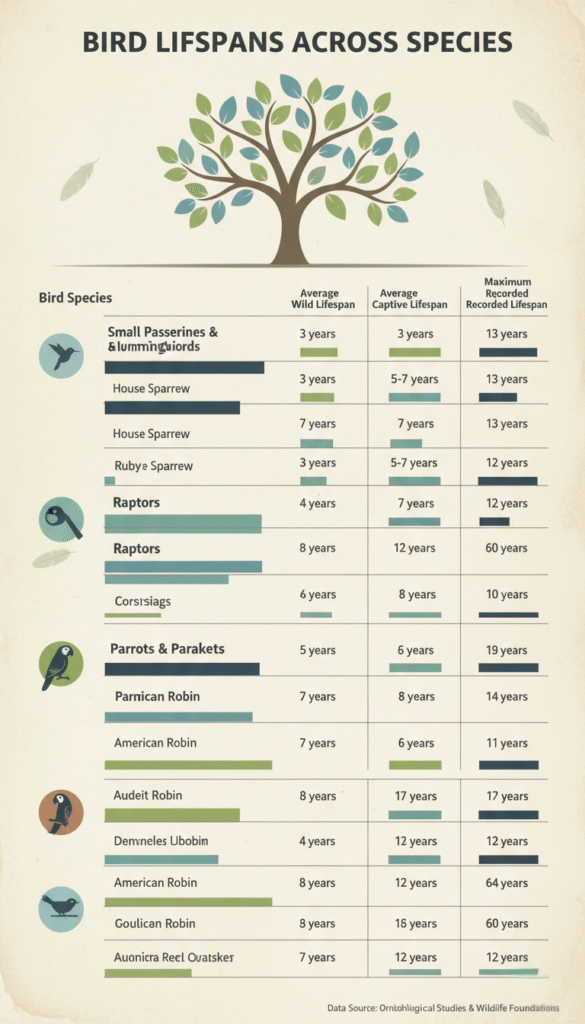
Comparison of Bird Lifespans Across Species
| Bird Species | Average Wild Lifespan | Average Captive Lifespan | Maximum Recorded Lifespan |
|---|---|---|---|
| Small Passerines & Hummingbirds | |||
| House Sparrow | 3 years | 5-7 years | 13 years |
| Ruby-throated Hummingbird | 3-4 years | 5-6 years | 9 years |
| American Robin | 2 years | 6-10 years | 17 years |
| Medium-sized Songbirds | |||
| Blue Jay | 7 years | 15 years | 17 years |
| Waterfowl & Waterbirds | |||
| Mallard Duck | 5-10 years | 10-15 years | 27 years |
| Canada Goose | 10-24 years | 30+ years | 33 years |
| Mute Swan | 15-20 years | 30-40 years | 40+ years |
| Raptors (Birds of Prey) | |||
| Peregrine Falcon | 7-15 years | 15-20 years | 25 years |
| Red-tailed Hawk | 10-15 years | 20-30 years | 29 years |
| Great Horned Owl | 13-15 years | 20-28 years | 38 years |
| Bald Eagle | 20-30 years | 40-50 years | 50+ years |
| Parrots & Parakeets | |||
| Budgerigar | 5-8 years | 10-15 years | 29 years |
| Cockatiel | 10-15 years | 20-25 years | 32 years |
| African Grey Parrot | 20-30 years | 40-60 years | 80+ years |
| Blue and Gold Macaw | 30-35 years | 50-60 years | 75 years |
| Seabirds & Penguins | |||
| Atlantic Puffin | 20-25 years | 30+ years | 36 years |
| Emperor Penguin | 15-20 years | 20-30 years | 34 years |
| Laysan Albatross | 40-50 years | 50-60 years | 74+ years |
| Other Unique Species | |||
| Ostrich | 30-40 years | 50-70 years | 70+ years |
| Kakapo | 60-90 years | 60-90 years | 90+ years |
Human activities significantly impact bird longevity, both positively and negatively. Understanding these effects helps us appreciate how long do birds live in modern environments and what we can do to support bird populations.
Negative impacts include habitat destruction reducing available nesting sites and food sources, which shortens average lifespans. Pesticides and pollutants cause direct mortality and long-term health issues. Climate change alters migration patterns and food availability, while window collisions kill hundreds of millions of birds annually. Domestic cats are estimated to kill billions of birds each year, dramatically affecting population numbers and average lifespans.
Positive impacts come from conservation programs that protect critical habitats and establish protected areas where birds can thrive. Bird feeders and water sources help how long do birds live survive harsh seasons.
Nest boxes provide safe breeding sites for cavity-nesting species. Rehabilitation centers treat injured birds and return them to the wild. Public education raises awareness about bird conservation, leading to actions that extend how long do birds live.
Bird banding programs have been instrumental in understanding how long birds live in the wild. By tracking individual birds throughout their lives, researchers have documented maximum lifespans and identified factors affecting survival rates. These studies reveal that first-year mortality is often extremely high, but birds that survive to adulthood have much better survival rates.
Helping Birds Live Longer in Your Backyard
If you’re interested in supporting bird populations and helping extend how long birds live, there are several actions you can take:
Provide quality food sources by offering appropriate bird feeders with species-specific foods. Black oil sunflower seeds attract many species, while nyjer seeds appeal to finches. Suet provides high-energy food for insect-eating birds. Keep feeders clean to prevent disease transmission.
Offer fresh water through bird baths, which provide both drinking water and bathing opportunities. Change water regularly and clean baths weekly. Consider adding a heating element in winter to provide year-round access.
Create safe habitats by planting native plants that provide natural food sources and nesting sites. Reduce lawn areas in favor of diverse plantings. Avoid pesticides that can poison birds directly or eliminate their insect food sources.
Prevent window strikes by applying decals, screens, or netting to windows. Birds don’t perceive glass as a barrier and often fly into windows at high speed. Simple preventive measures can save lives.
Keep cats indoors because outdoor cats kill billions of birds annually. If you have cats, keeping them inside protects both birds and your pets.
Provide nest boxes designed for specific species. Different birds require different entrance hole sizes and box dimensions. Clean boxes annually to prevent parasite buildup.
These actions help birds survive longer in the wild, extending both individual lifespans and supporting healthy populations.
The Role of Migration in Bird Lifespans
Migration significantly affects how long do birds live. Long-distance migrants face substantial risks during their journeys, including predation, exhaustion, starvation, adverse weather, and collisions with structures. These hazards contribute to higher mortality rates among migratory species compared to resident species.
Despite these risks, migration also offers benefits that can extend lifespans. Birds access abundant food resources by moving between summer breeding grounds and winter habitats. They avoid harsh winter conditions that would otherwise cause starvation or freezing. Following seasonal food availability allows migratory birds to maintain better body condition.
The Arctic tern makes the longest migration of any animal, traveling from Arctic to Antarctic and back each year, covering approximately 44,000 miles annually. These remarkable birds live 20-30 years on average, with some individuals reaching 34 years. Their ability to access productive feeding areas at both poles supports their longevity despite the migration risks.
Bar-tailed godwits hold the record for the longest non-stop flight, traveling 7,000 miles from Alaska to New Zealand without stopping. These birds live 15-20 years on average, demonstrating that even extreme migration challenges can be compatible with respectable lifespans.
Shorter-distance migrants and partial migrants (where some individuals migrate while others remain resident) often have intermediate survival rates. These strategies balance the benefits of migration against its costs.
Record-Breaking Bird Lifespans
When exploring how long do birds live, examining record-breakers provides fascinating insights into avian potential. These exceptional individuals often far exceed average lifespans for their species.
Wisdom, the Laysan albatross mentioned earlier, is the oldest known wild bird. Banded in 1956, she was still successfully raising chicks in 2024 at approximately 74 years old. Wisdom has likely flown over 3 million miles during her lifetime and raised at least 30-36 chicks.
Cookie, a Major Mitchell’s cockatoo at Brookfield Zoo in Chicago, lived to 83 years old before passing in 2016. She was the oldest living bird in a zoo at the time of her death.
Greater, a flamingo at Adelaide Zoo in Australia, lived 83 years from 1933 to 2014, making her one of the oldest birds ever recorded in captivity.
Poncho, an Andean condor, lived 79 years at Beardsley Zoo in Connecticut before dying in 2023, demonstrating the exceptional longevity possible for large birds in excellent captive conditions.
Among wild birds beyond Wisdom, a Manx shearwater was recaptured at 55 years old, having been originally banded in 1957. A fulmar was documented at 53 years, and a wandering albatross was confirmed at 63 years through banding records.
These exceptional cases show that while average lifespans provide useful information, individual birds under favorable conditions can far exceed expectations.
How Diet Affects How Long Birds Live
Nutrition plays a crucial role in determining how long birds live. The quality, variety, and availability of food directly impact bird health, disease resistance, and longevity.
Seed-eating birds require diverse seed types to obtain complete nutrition. Diets consisting of a single seed type often lead to nutritional deficiencies. Wild seed-eaters consume dozens of plant species throughout the year, obtaining different nutrients from each.
Insectivorous birds need protein-rich insects for optimal health. These birds often struggle during periods when insects are scarce. Supplemental feeding with mealworms or suet can help during challenging times.
Nectar-feeding birds like hummingbirds require high-energy food to fuel their rapid metabolisms. Sugar-water feeders help supplement natural nectar sources, especially during migration or when flowers are scarce.
Raptors and carnivorous birds need whole prey items that provide complete nutrition, including bones, organs, and fur or feathers. Captive raptors fed only muscle meat develop nutritional deficiencies affecting longevity.
Omnivorous birds benefit from varied diets including seeds, fruits, insects, and other protein sources. This dietary flexibility often correlates with successful adaptation to human-modified environments.
Calcium availability particularly affects female birds during breeding season. Calcium deficiency can cause egg-binding, a potentially fatal condition. Providing crushed eggshells or cuttlebone helps address this need.
Birds with access to diverse, high-quality food throughout the year generally live longer than those facing food scarcity or poor-quality nutrition. This factor explains much of the lifespan difference between captive and wild birds.
Disease and How Long Birds Live
Disease significantly impacts how long birds live, affecting both wild and captive populations. Understanding common bird diseases helps explain mortality patterns and survival rates.
Avian influenza periodically causes mass mortality events in wild bird populations. Waterfowl are particularly susceptible, and outbreaks can dramatically reduce local populations and shorten average lifespans.
West Nile virus affects many bird species, with corvids (crows, jays, magpies) particularly vulnerable. This mosquito-borne disease has caused significant mortality among American crow populations.
Salmonellosis spreads through contaminated food and water at bird feeders. Regular feeder cleaning helps prevent outbreaks that can kill dozens of birds in a local area.
Aspergillosis, a fungal disease, affects many bird species, particularly those exposed to moldy food or nesting materials. Captive birds are susceptible if housing is poorly maintained.
Psittacine beak and feather disease affects parrots, causing feather loss and beak deformities. This viral disease can significantly shorten affected birds’ lifespans.
Avian pox causes lesions and growths, particularly affecting birds around eyes and beaks. While not always fatal, it can impair birds’ ability to feed and see, indirectly causing death.
Trichomoniasis commonly affects pigeons, doves, and birds of prey. This parasitic disease causes lesions in the mouth and throat, preventing swallowing and causing starvation.
Access to veterinary care dramatically affects how long do birds live respond to disease. Early diagnosis and treatment of conditions that would be fatal in the wild allows captive birds to recover and continue living. Wild birds rarely receive such interventions, contributing to shorter average lifespans.
Genetic resistance to diseases also influences population-level longevity. Bird populations exposed to diseases over many generations may develop resistance, improving survival rates over time.
Climate and Environmental Factors
Climate and environmental conditions significantly affect how long do birds live. Birds face different challenges depending on their habitats and the seasonal variations they experience.
Temperature extremes can be deadly. Cold weather increases energy demands, requiring more food when it may be scarce. Hypothermia kills many small birds during harsh winters. Heat waves cause dehydration and heat stress, particularly affecting nestlings unable to regulate body temperature effectively.
Precipitation patterns influence food availability and nesting success. Drought reduces insect populations and seed production, causing starvation. Excessive rain can flood nests and increase parasite loads. Ice storms coat vegetation, preventing birds from accessing food.
Seasonal changes drive migration patterns and breeding cycles. Birds that mistimed migration or breeding due to climate change may face food shortages at critical periods, reducing survival rates.
Habitat quality directly impacts longevity. Birds in pristine habitats with abundant food, water, and nesting sites live longer than those in degraded environments. Fragmented habitats force birds to travel greater distances between resources, increasing predation risk and energy expenditure.
Altitude and latitude create different environmental challenges. High-altitude birds face thin air and extreme temperature fluctuations. Arctic and Antarctic birds endure extreme cold and long periods without sunlight.
Urban environments present both benefits and challenges. Cities offer year-round food sources through feeders and waste, providing consistent nutrition. However, urban hazards like windows, vehicles, and cats offset these benefits.
Island populations often show different lifespans than mainland populations of the same species. Island how long do birds live typically face fewer predators but may have limited genetic diversity and be more vulnerable to introduced threats.
Climate change is changing how long do birds live. It affects food availability and alters migration timing. It also increases extreme weather events and changes where birds can live. Species unable to adapt quickly face declining lifespans and populations.
Frequently Asked Questions About How Long Birds Live
What bird lives the longest?
The longest-lived birds are parrots and seabirds. Among parrots, cockatoos and macaws can live 50-80+ years in captivity.
Among wild birds, albatrosses hold longevity records, with Wisdom the Laysan albatross documented at 74+ years. The kakapo, a flightless parrot, can live 60-90 years. Overall, large parrots in excellent captive care probably achieve the longest lifespans of any birds.
Why do pet birds live longer than wild birds?
Pet birds live longer for several reasons. They do not face predators. They get regular veterinary care.
They have steady access to food and water. They are safe from bad weather. They also do not have to migrate.
Wild birds face constant survival challenges including predators, disease, starvation, injuries, and environmental hazards. A well-cared-for pet bird can easily double or triple the wild lifespan of its species.
How long do common backyard birds live?
Common backyard birds have variable lifespans. Robins average 2 years wild, 6-10 years captive. Blue jays live about 7 years wild, 15+ years captive.
Cardinals average 3-4 years wild, up to 28 years captive. House sparrows live about 3 years wild, 5-7 years captive. Chickadees average 2-3 years wild, 8-10 years captive. First-year mortality is high for all species, but adults that survive their first year typically live several more years.
Do larger birds live longer than smaller birds?
Generally yes, larger birds live longer than smaller birds. This pattern relates to metabolic rate—larger birds have slower metabolisms and longer generation times.
However, there are exceptions. Some medium-sized parrots outlive larger birds, and seabirds often live longer than similarly-sized land birds. Overall, the size-longevity relationship holds true across most bird groups.
How do scientists know how long do birds live?
Scientists determine bird lifespans through bird banding programs. They capture birds, attach uniquely numbered metal bands to their legs, and record data before releasing them. When banded birds are recaptured, found dead, or reported by others, researchers calculate their age from the original banding date.
Thousands of volunteer banders around the world have shared data for many years. This data shows the longest lifespans and average survival rates for hundreds of species.
Can birds die of old age?
Yes, birds can die of old age, though it’s relatively rare in wild birds. Most wild birds die from predation, disease, accidents, or starvation before reaching maximum age.
Captive birds that receive good care can still die from old age. They may suffer from organ failure, cancer, or other age-related issues. Very old wild birds may show signs of aging like arthritis, reduced vision, or worn feathers that make survival more difficult.
How long do hummingbirds live?
Hummingbirds typically live 3-5 years in the wild despite their incredibly fast metabolisms. The ruby-throated hummingbird averages 3-4 years, with a maximum recorded age of 9 years. Rufous hummingbirds average similar lifespans.
Hummingbirds can live longer in captivity with good care. They can reach ages of 10 to 12 years. However, they are rarely kept as pets because they have special needs.
What is the shortest bird lifespan?
Small songbirds have the shortest lifespans among birds. Many warblers, wrens, and finches average only 2-3 years in the wild. The shortest documented lifespans include some tropical species that may live less than 2 years on average.
It is hard to find minimum lifespans for birds. Many birds die before they are banded.
Also, high death rates in the first year make average lifespans low. “how long do birds live” Some birds do live much longer, but this affects the average.
Do birds in zoos live longer?
Birds in accredited zoos typically live longer than wild birds and often longer than pet birds due to expert care. Zoo birds receive specialized diets, veterinary care, enrichment activities, and monitoring. Many zoo longevity records exceed wild maximums by decades.
However, zoo birds must have appropriate social groups, adequate space, and mental stimulation to thrive. Poor zoo conditions can actually shorten lifespans below wild averages.
How does climate change affect how long do birds live?
Climate change affects how long do birds live lifespans through multiple pathways. Shifting food availability causes mismatches between breeding and peak food times.
Extreme weather events cause direct mortality. Changing habitats force birds into less suitable areas.
Altered migration patterns increase risks. New diseases spread to previously unaffected regions. Some adaptable species may gain from longer growing seasons. However, most evidence shows that climate change shortens lifespans for many bird species.
Conclusion
Understanding how long do birds live reveals the remarkable diversity and resilience of avian species. Bird lifespans vary greatly. Some tiny hummingbirds live only a few years. In contrast, ancient albatrosses and parrots can survive for decades.
The seven interesting facts we discussed show that a bird’s lifespan depends on several factors. These factors include their size, environment, diet, and the risk of being hunted. It also depends on whether they live in the wild or in captivity.
Small songbirds typically live only a few years in the wild, facing constant threats from predators and environmental challenges. Parrots represent the opposite extreme, with many species living 50-100 years given proper care.
Seabirds like albatrosses achieve remarkable longevity through evolved strategies for harsh marine environments. Birds of prey combine size and strength to reach impressive ages.
Waterfowl demonstrate that medium-sized birds can achieve considerable lifespans. Flightless birds often live longer than their flying relatives, and captivity consistently extends bird lifespans when care is appropriate.
For anyone who loves birds, understanding how long do birds live enriches our appreciation for these creatures. The robin visiting your feeder may be only two years old yet has already overcome tremendous odds to survive. The parrot companion in your home may outlive you, requiring planning for its future care.
The albatross flying over ocean waves may be older than many humans it meets. It has traveled millions of miles in its life.
We can help birds live longer by giving them good food and water. We should create safe homes for them. We can prevent window strikes and keep cats indoors.
Supporting conservation efforts is also important. Every action that helps birds survive contributes to extending how long do birds live both individually and as populations.
The question “how long do birds live” doesn’t have a single answer, but that complexity makes the topic fascinating. Each species has developed special ways to survive. They balance reproduction, growth, and lifespan to succeed in their environments.
Studying how long birds live helps us understand aging, adaptation, and conservation. This knowledge benefits all wildlife.
Whether you’re a casual bird watcher, dedicated ornithologist, or pet bird owner, understanding avian lifespans helps you better appreciate and protect these amazing animals. The next time you see a bird, think about its age. Consider the amazing journey it took to be there. This journey shows the lasting wonder of how long do birds live can live.
Leave a Reply